

Qi Wireless Charging: Why It Matters On The Go
Struggling to keep your iPhone or Android charged during busy international trips is a problem many frequent flyers face. The search for a charger that plays well with both Apple and Android devices often feels endless. Qi is an open standard for wireless power transfer that sidesteps these hassles, letting you power up without tangled cables or brand worries. This guide cuts through the confusion, revealing how Qi wireless charging streamlines your workflow with reliable, device-friendly tech that keeps pace worldwide.
Table of Contents
- Qi Wireless Charging Defined And Debunked
- How Qi Works: Inductive And Magnetic Tech
- Qi Versions: Evolution, Speed, Compatibility
- Comparing Qi To MagSafe And Wired Charging
- Practical Risks, Safety, And Best Use Tips
Key Takeaways
| Point | Details |
|---|---|
| Universal Compatibility | Qi chargers work across multiple brands and devices, making them ideal for travellers who use various smartphones. |
| Safety Features | Qi technology includes protocols for overcharging prevention and foreign object detection, ensuring safe charging practices. |
| Evolution of Speed | Modern Qi versions support faster charging up to 25 W, significantly reducing downtime during travel. |
| Maintenance of Battery Health | Wireless charging does not harm battery longevity when using certified products and following proper usage guidelines. |
Qi Wireless Charging Defined And Debunked
Qi wireless charging is far more straightforward than the acronym might suggest. At its core, Qi is an open standard for wireless power transfer managed by the Wireless Power Consortium, an international organisation with thousands of certified products worldwide.
Here’s how it actually works:
Electromagnetic induction is the clever bit. Your charger contains a transmitter coil, and your device contains a receiver coil. When you place your phone on a Qi-certified charger, these coils create a magnetic field that generates electrical current in your device’s battery. No cables required.
The system isn’t as magical as it sounds, though. You’re typically working within a 5 mm to 40 mm distance between your device and the pad. Get too far away, and the charging stops. The technology supports power levels commonly up to 15 W, which is respectable for everyday use on the go.
The safety and compatibility story matters here. Qi includes a built-in communication protocol that negotiates power requirements between your charger and device. This prevents overcharging, overheating, and incompatibility issues. That’s why wireless charging safety features are genuinely reliable.
Key facts about Qi charging:
- Supports major smartphone manufacturers globally
- Works through thin phone cases (under 5 mm)
- Requires no additional adapters or special cables
- Provides stable, consistent power delivery
- Certified products meet strict interoperability standards
Common misconceptions debunked:
Qi doesn’t drain your battery faster than wired charging. The efficiency loss is minimal. Qi doesn’t work with metal phone cases. Metal blocks the magnetic field, but most modern cases don’t use metal backing plates. Qi charging won’t damage your battery. The safety protocols prevent the damage-causing scenarios that worried people in early adopter days.
Qi is now the global wireless charging standard, adopted by virtually every major phone manufacturer and supported across tens of thousands of certified accessories worldwide.
Why this matters for your travels: Qi chargers are compact, cable-free solutions that fit naturally into baggage. Unlike proprietary charging systems, Qi compatibility means your charger works across multiple devices from different brands.
Pro tip: Invest in a compact, multi-coil Qi wireless charger for travel—multi-coil designs ensure faster charging and better positioning flexibility across different phone models and sizes.
How Qi Works: Inductive And Magnetic Tech
Qi wireless charging relies on two fundamental principles: inductive coupling and magnetic resonance. Understanding how these work reveals why your phone charges without plugging anything in.

The inductive charging process starts simple. Your charger pad contains a transmitter coil that generates an alternating magnetic field. When you place your phone on the pad, the device’s receiver coil sits in that field. Following Faraday’s law, the magnetic field induces voltage in the receiver coil, creating the electrical current that charges your battery.
Here’s the catch with pure inductive charging:
- Requires precise coil alignment for optimal efficiency
- Works best over very short distances (typically 5 mm or less)
- Power transfer drops significantly if coils aren’t centred
- Foreign object detection becomes tricky with misalignment
That’s where magnetic resonance improves the equation. Rather than relying on simple electromagnetic induction, resonant inductive coupling tunes both the transmitter and receiver circuits to vibrate at the same frequency. Think of it like two tuning forks matching pitch.
Magnetic resonance delivers several advantages:
- Works across greater distances (up to 40 mm in Qi systems)
- Maintains efficiency even with imperfect alignment
- Allows more flexible device placement on the charger pad
- Better tolerates obstacles between coils
Why this matters for travellers: You don’t need pixel-perfect positioning. Your iPhone or Android device can sit anywhere on a magnetic charging pad and still charge effectively.
Modern Qi chargers combine both inductive and resonant principles, automatically switching between them based on coil alignment and distance for optimal power transfer efficiency.
The communication layer adds another layer of sophistication. Your charger and device constantly communicate about power requirements, preventing overcharging whilst maintaining speed. This handshake happens through the same magnetic field that transfers power.
The practical upshot: Qi technology balances efficiency, safety, and convenience. You get reliable charging without worrying about precise placement, making it perfect for baggage compartments, hotel nightstands, or airport lounges.
Pro tip: Position your device in the centre of the charger pad when possible—whilst resonance handles misalignment well, centred placement maximises charging speed and minimises heat generation during long travel days.
Qi Versions: Evolution, Speed, Compatibility
Qi has evolved significantly since its launch. The standard wasn’t static—it’s been refined repeatedly to deliver faster charging, better alignment, and broader device support across the globe.
The timeline matters for your purchasing decisions. The Qi standard was first published in 2010), when wireless charging was still novel. Those early versions supported just 5 W of power, which charged phones painfully slowly. Modern versions support up to 25 W, delivering noticeably faster results for travellers who need quick top-ups between meetings.
Key versions at a glance:
- Qi v1.0 to v1.2 (2010–2015): 5 W charging, basic coil design
- Qi v1.2.2 (2015): Improved foreign object detection
- Qi v2.0 (2021): Extended power options, better efficiency
- Qi v2.2.1 (2025): Current standard with 25 W support
The Magnetic Power Profile (MPP) introduced in recent versions represents a genuine leap forward. Rather than relying on random placement, MPP uses magnets to perfectly align your device with the charger coils automatically. Your phone literally snaps into the optimal position. This improves charging speed and reduces heat generation—crucial when you’re charging multiple times daily whilst travelling.
Compatibility across devices has expanded dramatically. Apple, Samsung, Huawei, and Google all manufacture Qi-compatible phones now. This means your charger works worldwide, regardless of which brand dominates your region. A charger you buy in London charges the same way in Tokyo or Toronto.
Modern Qi versions combine faster power delivery with intelligent alignment technology, making wireless chargers genuinely practical for frequent travellers who demand both speed and reliability.
What hasn’t changed: All Qi versions remain backwards compatible. Your older charger works with newer phones, and newer chargers work with older devices. This matters for travellers carrying multiple devices from different generations.
Speed considerations matter when you’re on the move. A 25 W charger tops up an iPhone from zero to 50 percent in roughly 30 minutes. Compare that to 5 W versions taking 90 minutes, and the generational difference becomes obvious.
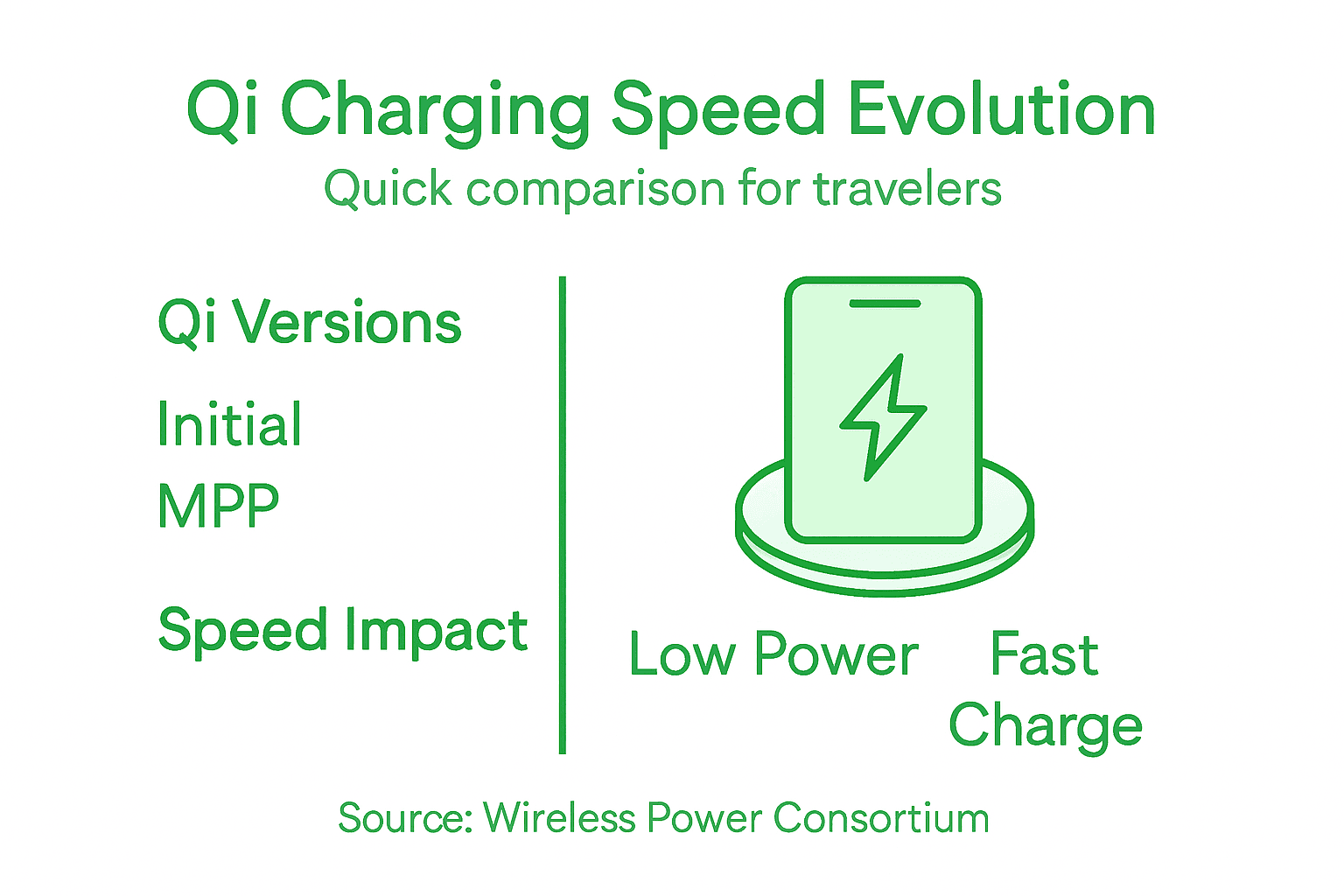
The table below summarises the progression of Qi wireless charging speeds over its major development phases:
| Qi Version | Maximum Power Output | Typical Charging Speed Improvement |
|---|---|---|
| v1.0 – v1.2 (2010–15) | 5 W | Slow, basic wireless experience |
| v2.0 (2021) | 15 W | Two to three times faster |
| v2.2.1 (2025) | 25 W | Rapid charging, ideal for travel |
Pro tip: When purchasing a travel Qi charger, look for models supporting the latest MPP standard—they charge faster and keep your device cooler during extended use, extending battery longevity over months of constant travel.
Comparing Qi To MagSafe And Wired Charging
Three main charging approaches compete for your attention when travelling: standard Qi wireless charging, Apple’s MagSafe, and traditional wired charging. Each has distinct trade-offs worth understanding.
Qi wireless charging remains the universal standard. It works across brands—Android, Apple, and everything in between. No cables, no proprietary connectors, just place your device on a pad. However, alignment matters. If your phone sits slightly off-centre, charging slows or stops entirely.
MagSafe builds directly upon Qi technology. MagSafe incorporates magnets for perfect alignment, meaning your iPhone snaps into the ideal position automatically. This delivers faster and more efficient charging than standard Qi. The catch: MagSafe currently works primarily on iPhones from model 12 onwards. Android adoption remains minimal.
Wired charging offers pure speed. High-wattage chargers deliver 20–140 W depending on your device, dwarfing wireless options. A flagship Android phone can charge fully in 20–30 minutes with the right wired charger. Wireless rarely matches that pace.
Here’s the practical comparison:
| Factor | Qi Wireless | MagSafe | Wired |
|---|---|---|---|
| Speed | 5–15 W | 15 W | 20–140 W |
| Universal support | Yes | iPhone 12+ only | Yes |
| Convenience | High | High | Medium |
| Cable-free | Yes | Yes | No |
| Alignment required | Yes | Automatic | N/A |
For travellers specifically, the decision hinges on your device ecosystem:
- Multi-device travellers (Android + iOS): Qi is your only universal option
- iPhone-only users: MagSafe eliminates alignment frustration whilst maintaining wireless convenience
- Speed-focused professionals: Wired charging with a fast charger remains unbeatable for emergency top-ups
Qi and MagSafe operate at similar power levels (up to 15 W), but MagSafe’s magnetic alignment delivers noticeably faster real-world charging because your device stays perfectly positioned throughout the charge cycle.
The heat factor matters during extended travel. Wireless charging generates slightly more heat than wired alternatives, though modern safety systems manage this effectively. MagSafe performs best here because perfect alignment minimises wasted energy.
Battery longevity considerations: Neither wireless technology damages batteries differently than wired charging when safety systems work properly. What matters is avoiding extreme heat, which both Qi and MagSafe handle better than high-wattage wired chargers.
The practical reality for on-the-go professionals: Carry a compact Qi charger for maximum compatibility, or invest in MagSafe solutions if you’re exclusively Apple-focused and value the automatic alignment advantage.
Pro tip: Combine both approaches when travelling—pack a lightweight Qi charger for flexibility and a wired fast charger for emergencies, giving you speed when you need it and convenience when time permits.
Practical Risks, Safety, And Best Use Tips
Wireless charging carries minimal risk when you use certified products properly. The science is reassuring: Qi chargers emit non-ionising radiation far below international safety limits set by regulatory bodies worldwide.
The real concerns are practical, not theoretical. Cheap uncertified chargers pose genuine dangers—they lack temperature control and foreign object detection, risking device damage and fire hazards. Your phone’s battery and components matter far more than radiation myths.
Here’s a concise overview of safety mechanisms found in Qi wireless chargers:
| Safety Feature | How It Works | Benefit for Users |
|---|---|---|
| Communication Protocol | Negotiates power usage and limits | Prevents overcharging and damage |
| Foreign Object Detection | Detects metal objects on pad | Stops unsafe charging immediately |
| Temperature Regulation | Monitors device and pad heat levels | Reduces risk of overheating |
| Certified Product Standard | Ensures compliance with Qi standards | Guarantees reliability and safety |
Medical device interference represents the only legitimate health consideration. If you use a pacemaker or implanted cardiac device, consult your doctor before using wireless chargers. Modern Qi chargers include safeguards, but medical devices warrant individual assessment.
Best practices for safe wireless charging:
- Purchase only Qi-certified chargers from reputable manufacturers
- Remove metal objects (keys, coins, cards) from charging pads before placing your device
- Avoid placing phones on chargers whilst wet or damp
- Ensure proper device placement for optimal coil alignment
- Don’t leave devices charging overnight repeatedly
- Check for heat during charging—warmth is normal, but excessive heat warrants investigation
Battery longevity depends more on charging behaviour than technology choice. Wireless chargers employ temperature regulation and adaptive power management to protect batteries. The real battery-draining culprit is leaving phones on chargers after they’re fully charged, whether wireless or wired.
Travel-specific safety tips matter. Airport scanners and metal detectors won’t damage wireless chargers. Your charger’s magnetic field is negligible. Hotel electrical outlets vary wildly in quality worldwide—using your own certified charger eliminates uncertainty about local power safety.
Certified Qi chargers with foreign object detection automatically shut down if metal or incompatible devices contact the pad, preventing short circuits and fires before they start.
Counterfeit products remain a genuine problem. Buying from authorised retailers—both online and physical shops—eliminates most fakes. Suspiciously cheap chargers often lack essential safety certifications.
Temperature management during travel: Your phone generates heat whilst charging, especially in warm climates. Wireless charging is actually gentler here because it avoids the high-current stress of fast wired charging. Provide airflow around devices during charging when possible.
Pro tip: Before travelling internationally, verify your charger’s voltage compatibility (typically 100–240 V) and pair it with a local power adapter rather than relying on hotel chargers—this single decision eliminates 90 per cent of travel charging problems.
Discover the Ultimate Solution for Seamless Qi Wireless Charging On the Go
The article highlights common challenges travellers face such as precise coil alignment, limited charging speed, and the need for safety features like foreign object detection and temperature regulation. If you want to enjoy fast, reliable wireless charging without fuss while travelling, Charg-R offers cutting-edge Qi-compatible chargers designed for today’s tech-savvy globetrotters. Featuring advanced multi-coil designs and the latest Magnetic Power Profile technology, our chargers ensure effortless device placement with optimal speed and safety.
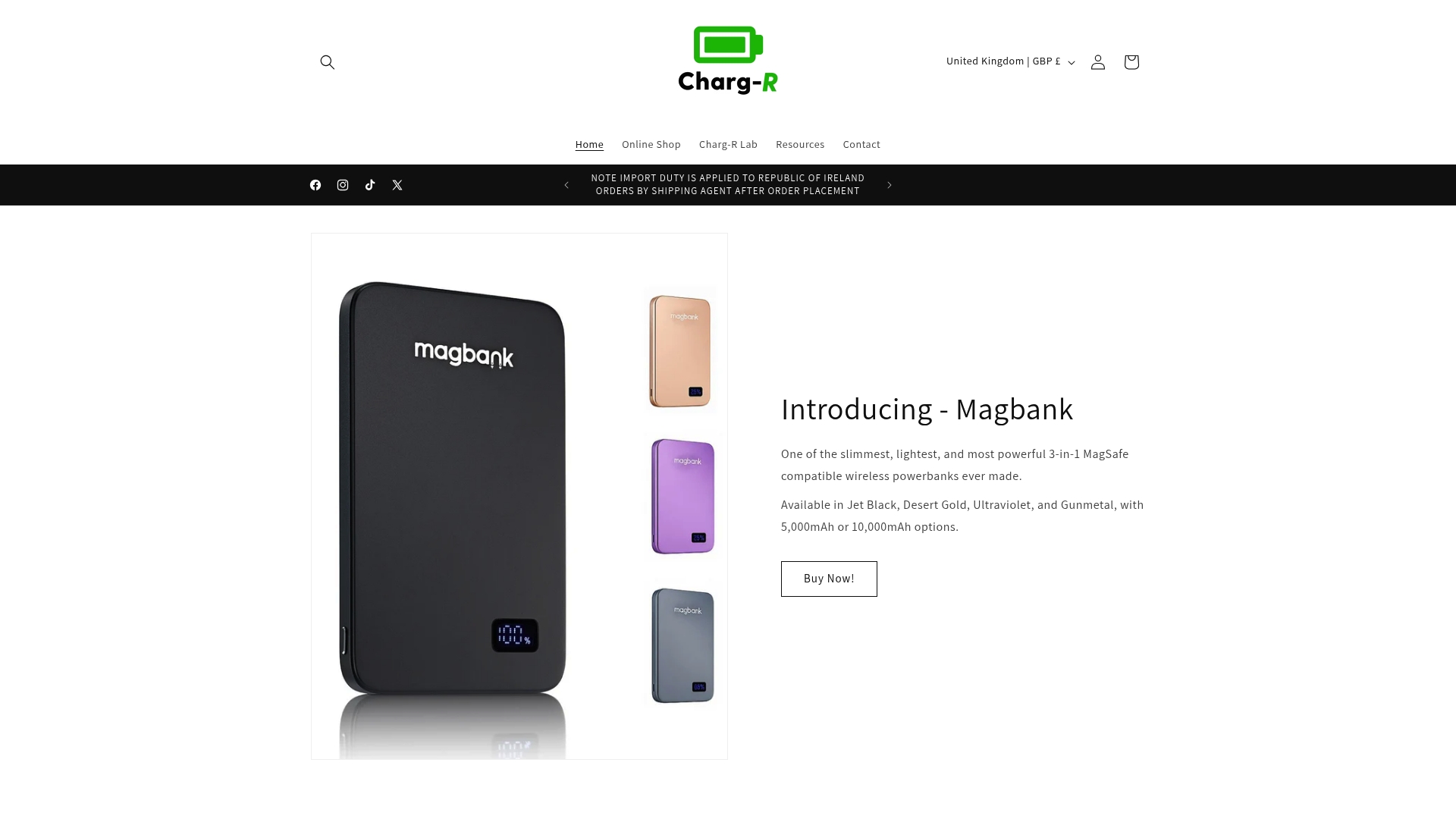
Upgrade your travel gear now and experience hassle-free power wherever you are. Browse our range of lightweight, fast-charging wireless chargers and multifunctional travel accessories at Charg-R. Don’t let battery anxiety ruin your trip — secure your perfect travel companion today and stay connected at all times.
Frequently Asked Questions
What is Qi wireless charging and how does it work?
Qi wireless charging is an open standard for wireless power transfer that uses electromagnetic induction to charge devices. It consists of a transmitter coil in the charger and a receiver coil in the device, generating a magnetic field that induces electrical current to charge the battery.
Is Qi charging safe for my smartphone battery?
Yes, Qi wireless charging has built-in safety protocols that prevent overcharging and overheating, making it safe for your smartphone battery. It does not damage the battery as long as a certified charger is used.
What are the advantages of using a Qi wireless charger when traveling?
Qi wireless chargers are compact and cable-free, allowing for convenient travel. They are compatible with multiple device brands, making them a versatile solution for charging needs on the go.
How does Qi wireless charging compare to MagSafe and wired charging?
Qi offers universal support across various brands but requires precise alignment for optimal charging. MagSafe provides better alignment with magnets for faster charging, while wired charging is usually the fastest option but requires cables. Each has its own advantages depending on user preferences.